
Inside Sourcefit’s AI Work
Sourcefit’s AI systems combine automation, workforce data and human teams. Its survey offers Australian employers a provider-specific view of adoption and governance.
Sourcefit AI work combines custom automation, an orchestration platform and performance analytics with human teams, according to the company. Its survey of 1,860 staff augmentation workers found that 68% reported productivity improvements, but the results are one provider’s snapshot, not an industry-wide measure.
In a feature published by BPOAI.ai in October 2026, founder and CEO Andy Schachtel discussed the systems Sourcefit has developed and what its own offshore staff say about AI. The survey ran from February to July 2026 across operations in the Philippines, South Africa, the Dominican Republic and Madagascar. Respondents worked in staff augmentation roles managed by clients.
Source: Inside Sourcefit’s AI Work
How Sourcefit AI connects people and operations
Sourcefit describes WorkingAI as a managed service that designs and implements custom AI within a client’s existing operations, often working alongside outsourced staff. The company says its approach pairs automation with expert teams, keeping a person involved when a task calls for human judgement. Its WorkingAI Accelerator Program is described as helping a client move to new, optimised processes in less than 30 days; that is a company statement, not a guaranteed outcome for every project.
“Automation creates more value when it is joined to operational context and human judgement.”
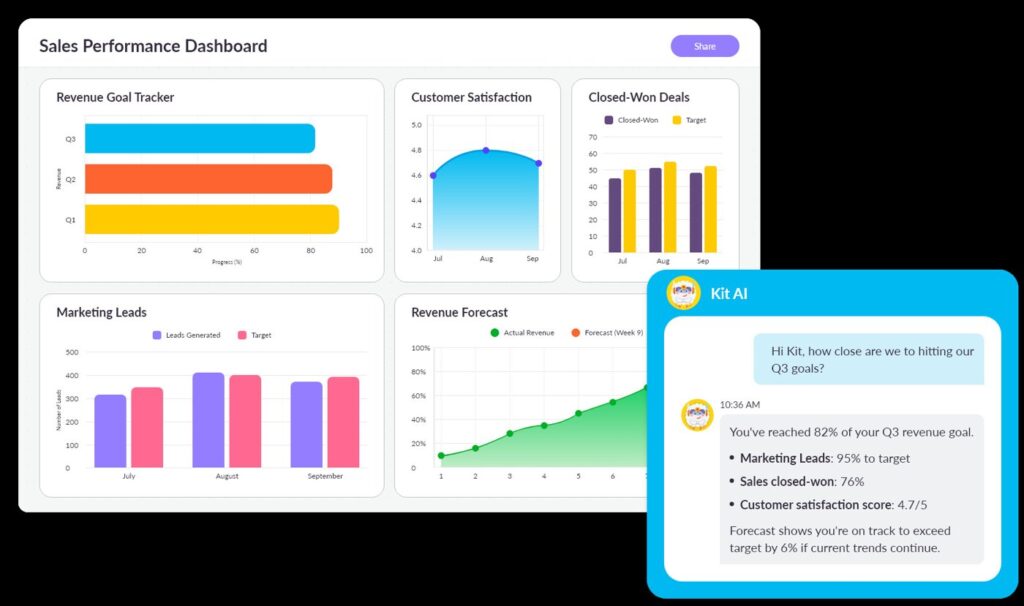
Underpinning that offer is Knit, which Sourcefit presents as an operating system for modern work. Its product deck lists functions including HR, accounting, project management, CRM, recruitment and IT helpdesk, alongside an AI assistant called Kit. The aim, as described by the company, is to bring automation, people data and operational reporting together rather than treat each as a separate layer.
Sourcefit’s PulseBI product is one example of that connection. It brings people signals from Knit—such as training attendance and scores, coaching feedback and schedule adherence—together with contact-centre measures including average handle time, customer satisfaction scores and queue times. Sourcefit says these inputs form a Pulse Score for each agent, covering predicted performance and risk. Teams can then use the combined view to identify where coaching may have been missed, performance may be slipping or attrition risk may need attention.
The company says the approach existed in practice before PulseBI became a product. It points to an account with a direct-to-consumer eyewear client that it says remained above target for seven years. Sourcefit attributes that result to linking coaching with quality assurance, scheduling with occupancy, and training with customer satisfaction. It describes PulseBI as the system that now makes those connections visible in real time.
In 2026, Knit and WorkingAI received a Gold Stevie at the Asia-Pacific Stevie Awards in the Excellence in Innovation in Artificial Intelligence category, for organisations with 100 or more employees. Sourcefit was also named a winner in the Artificial Intelligence category of the 2026 Fortress Cybersecurity Awards, run by the Business Intelligence Group. These awards provide context about the company’s AI work; they do not by themselves establish how a particular implementation will perform for a buyer.
Governance built into the system

For employers considering AI-enabled outsourcing, the controls around a tool matter as much as its functions. Sourcefit says it uses AI in production with sensitive client data and has built an internal AI governance platform to support that work. In its account, permissions are enforced at database and credential level before an agent can act: an AI agent should retrieve only authorised rows, and its actions are recorded. Where an action requires review, the company says a person must approve it.
Sourcefit says its platform is aligned to ISO/IEC 42001, the international standard for responsible AI management. Alignment is the company’s description of its approach; buyers should clarify what evidence supports that claim, which systems and processes it covers, and how the controls are reviewed when a tool or workflow changes.
The company also reports that it has reduced the time required for firewall queries and compliance validation by more than 95%. That figure is Sourcefit’s own reported result. An employer assessing a provider can ask what was measured, over what period, and whether the same measure is relevant to the buyer’s data, systems and operating environment.
Schachtel argues that governance needs to be demonstrable, rather than presented as a general commitment:
“A provider who can name a recognized standard and prove they meet it is in a different category from one who just says they take AI seriously.”
Andy Schachtel, Founder & CEO, Sourcefit
What the people doing the work say

Sourcefit’s survey gives a workforce view of AI adoption within its own operations. Among the 1,860 respondents, 74% said they used AI tools at least occasionally, while 52% reported using them daily or several times a week. In the survey, 68% said AI had moderately or significantly improved their productivity, and 66% felt confident using it daily.
On the question of job impact, 7% said they believed AI might reduce or eliminate parts of their role. Another 41% expected AI to support their role without fundamentally changing it. These are staff members’ reported views, collected in a survey run by their provider. They are useful as a view from people doing the work, but should not be treated as a prediction for the broader outsourcing workforce.
Respondents most often named writing and documentation as an AI use case (36%), followed by research and analysis (30%) and customer support (14%). Limited access to tools was the most frequently named barrier (30%), ahead of security concerns (20%). For buyers, those responses point to practical questions: are teams equipped with approved tools, do workers know when to use them, and can the provider explain how access and information security are managed?
Schachtel’s view is that AI can narrow the output gap between offshore and onshore teams, while cultural and social understanding remains a human contribution and AI output still often needs people in the loop. He linked the survey’s reported productivity gains to staff feeling better able to do their work:
“People aren’t afraid of a tool that’s actually making them better at their job.”
Andy Schachtel, Founder & CEO, Sourcefit
Employers planning a transition should consider the learning and change-management needs alongside the technology. GWS has additional reading on skills development and professional learning, as well as the role of practical and transferable skills.
“A provider who can name a recognized standard and prove they meet it is in a different category from one who just says they take AI seriously.”Andy Schachtel · Founder & CEO, Sourcefit
What Australian buyers should ask a BPO before signing
Sourcefit’s case study suggests that an AI conversation with an outsourcing provider should move beyond a product demonstration. Ask which tasks the proposed system will perform, where human review remains necessary, what information the system can access and how its actions are recorded. Request examples tied to the process you intend to outsource, rather than relying on broad claims about automation or productivity.
Then examine governance. Ask which recognised standard informs the provider’s controls and what documentation can be reviewed. If a provider says it is aligned to ISO/IEC 42001, clarify the scope of that alignment, how oversight works in practice and how changes to tools or workflows are assessed. Buyers should also ask how permissions are set, how exceptions are handled, who approves sensitive actions and what evidence is available for audit or review.
Workforce readiness deserves equal attention. Ask how staff are trained, whether they have access to approved tools, what support is available when an AI output is uncertain, and how roles and workflows may change. The survey’s finding that limited tool access was a commonly reported barrier is a reminder to check that a provider’s adoption plan addresses day-to-day working conditions, not only technical deployment.
Finally, agree on how performance will be evaluated. Identify the service measures that matter to your operation and how they will be reported alongside any people or quality signals. Sourcefit’s description of PulseBI connects training, coaching and schedule data with contact-centre results; a prospective client should establish which measures are meaningful for its own service and how they will inform action.
Schachtel also referred to the EU AI Act as setting a bar in 2026 and said he expects AI compliance to tighten. Buyers should seek current, project-specific advice on applicable obligations rather than rely on a provider’s general summary. The BPOAI directory describes its tiers and AI badges as earned, intended to indicate that readiness has been checked rather than simply claimed. The article also notes that Sourcefit’s directory profile is claimed and managed by the company, with its credibility score pending review.
For Australian employers working through a wider workforce gap, GWS also outlines approaches to addressing workforce shortages and capability needs. The useful question is not whether AI should replace people or be adopted everywhere; it is where a defined tool can support a well-governed process and a capable team.
About Andy Schachtel
Andy Schachtel is the founder and CEO of Sourcefit, a global outsourcing company. The BPOAI.ai feature says AI helped draft its article, which the editorial desk reviewed and edited, checking facts against the original source. It invites readers to view Sourcefit’s directory profile and share the story with other BPO leaders; those editorial prompts are separate from the buyer checks set out here.
Turning the case study into a workforce brief
Sourcefit’s survey offers a provider-specific account of how staff experience AI, while its products illustrate one way automation, workforce information and operational measures can be joined. For Australian employers, the practical lesson is to assess the workflow, controls, human oversight and evidence together—and to treat provider-reported results as claims to examine against your own needs.
To discuss an offshore recruitment need or submit a workforce brief, contact Global Workforce Solutions with the roles, capabilities and operating context your team needs. That gives GWS a practical starting point for discussing the workforce requirement with you.